
(Image from ICanHasCheezburger.)
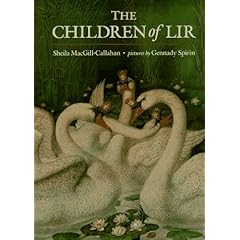 The Children of Lir written by Sheila MacGill-Callahan, illustrated by Gennady Spirin. I actually like the sadder, more familiar, Christianized version of this story better, but as a child, I would have appreciated MacGill-Callahan's happy ending, the addition of Jasconius the whale (borrowed from the legend of Saint Brendan), and the large role played by animals throughout the story. Spirin's detailed illustrations are both fantastical and formal, reminding me of a Renaissance stage play.
  The King of Ireland's Son, told by Brendan Behan and illustrated by P.J. Lynch, was transcribed from a audio-recording of Behan, and the text vibrantly reflects the best qualities of oral storytelling. The story is light-hearted and lyrical, and Lynch's pictures are a perfect match: the characters are lovingly detailed and humorously expressive.
 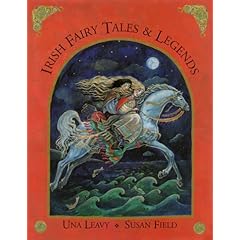 Irish Fairy Tales and Legends, written by Una Leavy and illustrated by Susan Field, is possibly my favorite of the three. First, you get ten tales to delight in, instead of one. Second, Leavy does the best job I've ever read of staying true to the nature of old Irish legends while fitting them into a language and tone appropriate for children. Third, the collection is a generous mix of serious and comic stories. Fourth, Field's pictures are absolutely marvelous: expressive, warm, colorful, and childlike.
The Incarnation appealed to the literature buff in me. Embodiment was the novelistic culmination of anthropomorphism, of assigning God human characteristics. All through the Torah, God is pictured as having hands, a face. The rabbis say, Of course God doesn't really have hands, but the Torah uses the language of hands and faces and eyes so that we will have an easier time wrapping ours minds around this infinite, handless God. That is what you say if you are a rabbi. But if you are a good novelist, you actually give him Him hands and eyes by the end of the book, and that is what the Bible does. It says, in Deuteronomy, that God brought us out of Egypt with a mighty hand and an outstretched arm; and then it gives Him an arm in the Gospel of Matthew (51-2).
I track down the artist. Her name is Diane and she lives in New Mexico. I email her and ask if the papercut of Ruth 1:21 is available for sale. She writes back: She will sell me the picture for $900. It is Friday afternoon that we exchange these emails, and she wishes me a Shabbot shalom, and I think, Of course, she thinks I'm Jewish. I half-feel I am deceiving her by not spilling my entire religious autobiography to her over email. (Are you sure you want to sell your art to a traitor?)
When the papercut comes in the mail, I unwrap it with some ceremony, and hold it in my hands for a long time and then I hang the papercut on a wall with crosses--a sturdy, orange clay cross that I bought at that Episcopal church in Oxford, Mississippi, and a trio of iron crosses, Jesus' and the two thieves', that I found at a small craft shop in North Carolina. It hangs underneath those, and it looks delicate and just slightly out of place, like a bit of lace peeking out of a heavy woolen winter coat.
"It is a difficult verse," Diane writes to me in her email. "The challenge for me was to capture the loneliness of the verse, and still imbue it with a sense of beauty. I suspect it reflects difficult losses for you" (249-50).

