Showing posts with label YA/juvenile lit.. Show all posts

Thursday, February 18, 2016

Reading Challenge Update for 2015 (Part 2 of 2)

Every year, the number of books I read, the genres I read the most, and the challenges I pursue change. But one thing remains the same. . .I always forget how freaking long it takes to organize this post.

Beyond the PopSugar challenge I posted already, my other reading goals for 2015 were to read
  • at least seven books that are either collections of poetry or books about poetry (Done!)
  • at least one book by a Nobel-prize-winning writer whose work I'm not well-acquainted with (Nadine Gordimer)
  • two Pulitzer-winning books, at least one of them fiction (This one I didn't manage. I did read two Pulitzer-winning books, but they were both poetry. I'd been trying to finish All the Light We Cannot See since before it won the Pulitzer, but there was a huge hold list for it at the library and I kept having to return it before I was finished.)
  • literature from South Africa (Africa39, which contained three short stories by South African authors, and July's People by Nadine Gordimer)
  • literature from Lesotho, focusing particularly (though not exclusively) on work relating to the Zulu people (Chaka by Thomas Mofolo is a fictional retelling of the history of a famous Zulu king) 
  • Fifty books (I'll let you scroll down and see the list for yourself)

Key:
Fiction
Poetry
Nonfiction
YA or middle-grade 
Memoir
Play
Underline of any color= graphic novel/comic book  


1. Watch for the Light: Readings for Advent and Christmas—various authors 
2. The Art of Fielding—Chad Harbach (reread)
3.  The Yiddish Policemen’s Union—Michael Chabon
4.  Relish: My Life in the Kitchen—Lucy Kinsley
5. Ms. Marvel, Vol. 1: No Normal—written by G. Willow Wilson, art by Adrian Alphona
6. Batgirl, Vol. 1: Silent Running—written by Kelley Puckett and Scott Peterson, art by Damion Scott and Robert Campanella
7. Bone: The Great Cow Race—Jeff Smith
8. Fun Home: A Family Tragicomic—Alison Bechdel
9. In the Open—Beatrix Gates  
10. Behind the Beautiful Forevers—Katherine Boo
11. Return of the Dapper Men—written by Jim McCann, art by Janet K. Lee
12. Justice League International, Vol. 2—written by Keith Giffen and J.M. DeMatteis, art by Kevin Maguire and Bill Willingham 
13. Bone: Eyes of the Storm—Jeff Smith
14. How Mirka Got Her Sword (Hereville #1)—Barry Deutsch
15. Gaijin: American Prisoner of War—Matt Faulkner
16. Diadem Me—Bethany Carlson
17. Shadow Hero—written by Gene Luen Yang, art by Sonny Liew
18. How Mirka Met a Meteorite (Hereville #2)—Barry Deutsch
19. Alpha Zulu—Gary Copeland Lilley  
20. Marbles: Mania, Depression, Michelangelo & Me—Ellen Forney
21. Neurocomic—Dr. Matteo Farinella and Dr. Hana Roš
22. Batman and Robin, Vol. 3: Death of the Family—written by Peter Tomasi and Scott Snyder; art by Patrick Gleason, Ardian Syaf, Greg Capullo, Mick Gray, Vicente Cifuentes, Keith Champagne, Jonathan Glapion, John Kalisz, FCO Plascencia, etc.
23. Mister Orange—Truus Matti, trans. from the Dutch by Laura Watkinson
24. New Covenant Bound—Tony Crunk (reread)
25. Hawkeye, Vol. 2: Little Hits—written by Matt Fraction; art by David Aja, Steve Lieber, Jesse Hamm, Francesco Francavilla, and Matt Hollingsworth
26. Runaways, Vol. 1: Pride & Joy—written by Brian K. Vaughan; art by Adrian Alphona, David Newbold, Craig Yeung, Brian Reber, etc. 
27. Bone, Vol. 4: The Dragonslayer—Jeff Smith
28. At Home: A Short History of Private Life—Bill Bryson
29. Trillium—Jeff Lemire
30. Zita the Spacegirl—Ben Hatke
31. Through the Woods—Emily Carroll
32. Bone, Vol. 5: Rock Jaw—Master of the Eastern Border—Jeff Smith
33. Marvel Super Heroes Secret Wars—Jim Shooter (and many others)
34. Heavenly Bodies—Cynthia Huntington
35. The Museum of Extraordinary Things—Alice Hoffman
36. On Gold Mountain—Lisa See
37. The Thrilling Adventures of Lovelace and Babbage: The (Mostly) True Story of the First Computer—Sydney Padua
38. Fangirl—Rainbow Rowell
39. The Worst Hard Time: The Untold Story of Those Who Survived the Great American Dust Bowl—Timothy Egan
40. In Real Life—written by Cory Doctorow, art by Jen Wang
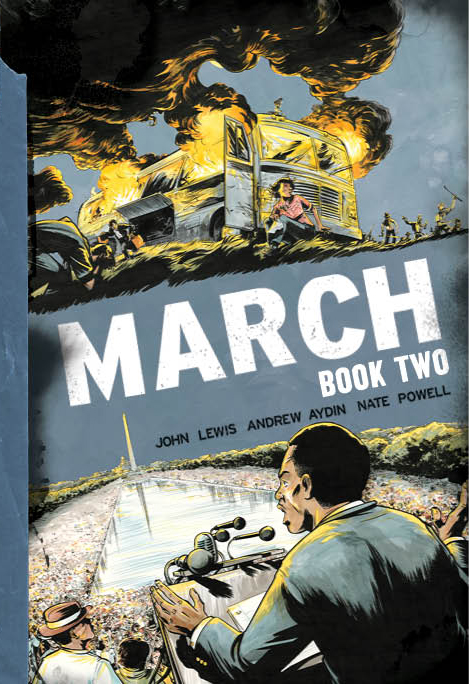
41. March, Book 2John Lewis and Andrew Aydin, art by Nate Powell
42. Leaving Megalopolis—written by Gail Simone, art by J. Calafiore and Jason Wright
43. Africa39: New Writing from Africa South of the Sahara—edited by Ellah Wakatama Allfrey (three authors from South Africa in collection)
44. Batman Incorporated, Vol. 2: Gotham’s Most Wanted—written by Grant Morrison, Chris Burnham, Joe Keatinge, Mike Raicht, Dan Didio, and Ethan Van Sciver; art by Chris Burnham, Jason Masters, Nathan Fairbairn, Hi-Fi, Andrei Bressan, Jorge Lucas, Ian Hannin, Dave McCraig, Emanuel Simeon, Brett Smith, John Stanisci, Art Lyon, Dan Didio, and Ethan Van Sciver, etc.
45. Batman and Robin, Vol. 4: Requiem for Damian—written by Peter J. Tomasi; art by Patrick Gleason, Mick Gray, Cliff Richards, Mark Irwin, Marlo Alquiza, John Kalisz, etc.
46. Delights and Shadows—Ted Kooser
47. Mink River—Brian Doyle
48. Diniwe in Dreamland—Desmond Dudwa Phiri 
49. The Cute Girl Network—written by Greg Means and MK Reed, art by Joe Flood
50. Asterios Polyp—David Mazzucchelli
51. Stitches—David Small
52. Cold Mountain—Charles Frazier
53. The Sculptor—Scott McCloud
54. Grayson: Agents of Spyral, Vol. 1—written by Tim Seeley and Tom King; Stephen Mooney, Jeromy Cox, Mikel Janín, Guillermo Ortego, Juan Castro, Carlos M. Mangual, etc.
55. Robot Dreams—Sara Varon
56. Batman and Robin, Vol. 5: The Big Burn—written by Peter Tomasi, art by Patrick Gleason
57. Runaways, Vol. 2: Teenage Wasteland—written by Brian K. Vaughan, art by Adrian Alphona
58. Crashboomlove: A Novel in Verse—Juan Felipe Herrera
59. Wuthering Heights—Emily Brontë (reread)
60. Wonder Woman, Vol. 3: The Circle—written by Gail Simone; art by Terry Dodson, Bernard Chang, Ron Randall, and Rachel Dodson  
61. Cinder—Marissa Meyer
62. The Compleat Terminal City—Dean Motter
63. Lots of Candles, Plenty of Cake—Anna Quindlen
64. Griffin and Sabine Trilogy (Griffin & Sabine, Sabine’s Journal, and The Golden Mean)—Nick Bancock
65. Boundaries: When to Say YES, When to Say NO, to Take Control of Your Life—Dr. Henry Cloud and Dr. John Townsend
66. Gemini—Carol Cassella
67. Batman Eternal, Vol. 1—written by Scott Snyder, James Tynion IV, John Layman, Ray Fawkes, Tim Seeley, Kyle Higgins; art by Jason Fabock, Dustin Nguyen, Mikel Janin, Guillem March, Ian Bertram, Riccardo Burchielli, Andy Clarke, Trevor McCarthy, Emanuel Simeoni, Derek Fridolfs, Guillermo Ortego, Brad Anderson, John Kalisz, Blond, Jeromy Cox, Tomeu Morey, Guy Major, Dave McCaig, Dave Stewart, etc.
68. Hawkeye, Vol. 3: L.A. Woman—written by Matt Fraction, art by Annie Wu and Javier Pulido
69. Chaka—Thomas Mofolo, trans. Daniel P. Kunene
70. July’s People—Nadine Gordimer (Nobel Prize winner)
71. Absalom! Absalom!—William Faulkner
72. American Primitive—Mary Oliver (Pulitzer Prize)
73. The Diary of a Young Girl—Anne Frank, trans. Susan Massotty
74. The Winter’s Tale—William Shakespeare

Or to break it down:
32 works of fiction, 20 of them graphic novels/trade comic collections and 12 works of adult (non-graphic-novel) fiction
19 works of YA or middle-grade fiction, 15 graphic novels/comic collections and 4 novels (although deciding what counted as part of this category was difficult)
9 works of nonfiction, 8 prose and 1 graphic nonfiction
8 works of poetry
 5 memoirs (all of them graphic memoirs)
1 play
41 (!) comic collections and graphic novels
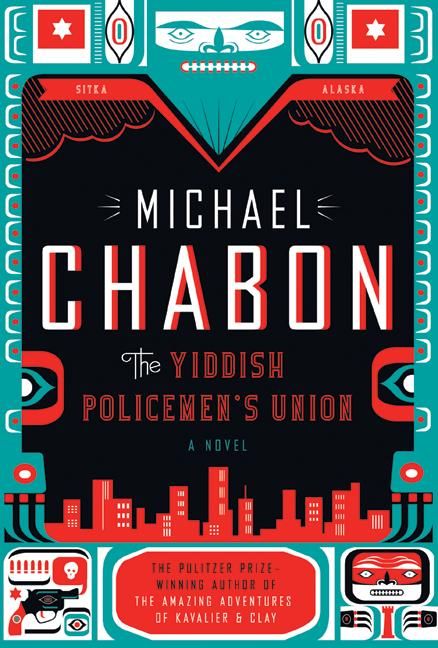
Favorite adult fiction:The Yiddish Policemen’s Union—Michael Chabon. This isn't much of a surprise to me; The Amazing Adventures of Kavelier and Clay is one of my favorite books. I love the playful way Chabon writes complex, verbose sentences, as though he is inviting you into a game rather than simply showing off. It's a murder mystery and a love story and a neo-noir alternative history of the 1980s. What more could you want?

Favorite work of nonfiction: Boundaries: When to Say YES, When to Say NO, to Take Control of Your Life—Dr. Henry Cloud and Dr. John Townsend. A lot of the principles in the book weren't new to me (and it does have some of the flavor of a nineties self-book), but I still find myself wanting to hand it out to strangers on the street, like some kind of Oprah of good emotional/spiritual health: "You get good boundaries! And you! And you!"  

Favorite poetry: It's a serious stretch to pick just one. I read a lot volumes this year that I found myself recommending to others, including one by a college classmate (Diadem Me by Bethany Carlson). But my favorite was actually an old favorite: New Covenant Bound by Tony Crunk. We read it in my book club, and I worried that I might find my enthusiasm for the book had dampened over time. But I loved it every bit as much as the first time.

Favorite memoir: Again, I liked a lot of what I read in this category for 2015 (and I'm not a huge memoir fan—graphic or otherwise). But March (John Lewis, Andrew Ayden, and Nate Powell) wins. Don't avoid it just because you think you already know this story.

Favorite YA/middle-grade: Ms. Marvel, Vol. 1: No Normal. Origin stories can get repetitive, but G. Willow Wilson handles this one with expert care and humor. Kamala Khan is a character I feel like I've been subconsciously waiting for. A breath of fresh air.

The contest for my favorite book read in 2015 ended in a tie.

Asterios Polyp (David Mazzucchelli) is book I shouldn't have liked (an egoistical architectural professor has a midlife crisis) but that I ended up loving. If you think graphic novels can't be pieces of serious literary fiction, you need to read this book. I've never seen every bit of a graphic novel's visual art (lettering, coloring, line thickness, panel-size, etc.) play into the theme and character development quite like this before. Amazing work.

The Thrilling Adventures of Lovelace and Babbage (Sydney Padua) is technically fiction. But it is hands-down the best researched book I read in 2015. It's half footnotes. And the footnotes are delightful. It has all the fun of a steampunk adventure, and Padua's characters leap off the page (sometimes, out of their panels), but you will leave the book remembering more history about Victorian England and the first computer than if you had read a slew of biographies. I highly recommend this graphic novel, even if, like me, you think you aren't that interested technological histories.


Here, I usually list the "other books" I've read: things that were too short (or not "word/narrative heavy enough") to make the previous list. But given the number of individual comic book issues I read in 2015, this list is longer than usual. So I've included it below for consistency's sake, but I'm happy to leave you here. In my next post, I'll probably talk about my reading goals for 2016.

But what were your favorite reads of 2015?

Other:
The Power of Shazam! The Arson Fiend, #2—written by Jerry Ordway; art by Peter Krause, Mike Manley, Glen Whitmore, and John Constanza  
Power Pack: Star Struck, #58—written by Michael Higgins; art by Tom Morgan, Nel Yomtov, and Joe Rosen
Batman: Legends of the Dark Knight: Infected, Part OneWarren Ellis and John McCrea
Batman: Legends of the Dark Knight: Infected, Part TwoWarren Ellis and John McCrea
Raising Dion, #1­—written by Dennis Liu; art by Jason Piperberg
The Princess and the Pony—Kate Beaton
Cheetah Can’t Lose—Bob Shea
Robin: Buggin’, #23—written by Chuck Dixon; art by Aaron Lopresti, Stan Woch, Adrienne Roy, and Tim Harkins
Detective Comics: Rite of Passage: Shadow of the Sun, Part One, #618—written by Alan Grant; art by Norm Breyfogle, Dick Giordano, Adrienne Roy, etc.
World’s Finest: Worlds Apart, #1—written by Dave Gibbons; art by Steve Rude, Karl Kesel, and Steve Oliff
Green Lantern: Among My Souvenirs, #4—written by Gerard Jones; art by Pat Broderick, Bruce Patterson, Albert De Guzman, Anthony Tollin, and Kevin Dooley
Showcase 94 (Benedictions—Part 3: Vengeance and Forgiveness; Sparx!: Allure of New Orleans; The Atom: The Uncertainty Principle), #6—written by Chuck Dixon, Karl Kesel, and Len Kaminski; art by Phil Jimenez, Peter Gross, Tom McCraw, Scott Lee, Phil Allen, Brad Vancata, Fred Reyes, Rick Burcheett, Robbie Busch, etc.
Batgirl: Fresh Blood—Part Four, Settling Up, #59—written by Andersen Gabrych; art by Ale Garza, Jesse Delperdang, Wildstorm FX, and Rob Leigh
The Return of Donna Troy: A Golden Age to Conquer, #1—written by Phil Jimenez; art by José Garcia-Lopez, George Pérez, Martin Breccĭa, Nestor Preyra, Lee Loughridge, and Ken Lopez
Power Pack: Whose Power?, #27­—written by Louise Simonson; art by Jon Bogdanove, Al Gordon, Joe Rosen, and Glynis Oliver
Step Aside, Pops: A Hark! a Vagrant Collection—Kate Beaton
Batman: The Cult—Book One: Ordeal—written by Jim Starlin; art by Berni Wrightson, Bill Wray, John Costanza, etc.
Batman: The Cult—Book Two: Capture—written by Jim Starlin; art by Berni Wrightson, Bill Wray, John Costanza, etc.
The SheepOver—John and Jennifer Churchman
Days with Frog and Toad—Arnold Lobel (reread)
Frog and Toad Together—Arnold Lobel (reread)
The Secret Remedy Book—written by Karin Cates, illustrated by Wendy Anderson Halperin (reread)
The Magic of Millicent Musgrave—Brinton Turkle


Images from HarperCollins, The University Press of Kentucky, Top Shelf ComicsKnof Doubleday, and Knof Doubleday

Wednesday, October 12, 2011

Sidekicks by Jack D. Ferraiolo


(Warning: The book discussed in today’s post deals with young male sexuality. Since I have never been teenage boy, this is bound to be awkward. Since I am full of unverified opinions on all kinds of topics, this is bound to be very soap-box-y.)

Now that I’m blogging again, what work of classic literature am I going to tackle first?

                                                                                                                             
I’ve been on a bit of a superhero kick lately (no pun intended), and I have a long-standing love for juvenile/YA fiction.  

Sidekicks (Amulet Books 2011), a middle-grade superhero novel by Jack D. Ferraiolo, seemed like a perfect fit.

I enjoyed the middle of this book. Once the arch-nemesis is revealed the story picks up speed, the dialogue becomes both more interesting and more believable, and the plot takes several unexpected turns. It was all good, action-driven fun. 

But the beginning and the end gave me some problems. 

The book is marketed as middle school fiction (Amazon suggests ages 10 and up), and for the most part it reads like light-hearted, slightly satirical middle grade fare. But the story begins with the hero, Scott Hutchinson (a.k.a. Bright Boy) rescuing a woman and, to his great embarrassment, experiencing an erection. All while news teams film him and shout insults.

A recurring debate in juvenile fiction is whether to mention sex and puberty and how much to mention. To oversimplify, the arguments for introducing sexual changes generally fall under two categories: 1) that this makes the story more realistic and the characters more relatable and 2) that this lets kids know that puberty is normal and nothing to be ashamed of.

Sidekicks sets itself up as a realistic (give or take a little for the sake of comedy) comic book story. Phantom Justice and Bright Boy fight in our New York City (rather than in a stand-in like Gotham or Metropolis). They have our technology and something of a medical explanation for superpowers. Yet the morning news show continually replays the footage of Scott’s boner. I had some trouble buying that premise. It’s no surprise that the media can be cruel to young celebrities (Rebecca Black, anyone?). But the coverage Ferraiolo depicts seems more likely for late night shows and internet sites. And the news plays nothing but that clip for about twenty minutes. No news day is that slow. 

When Scott goes to school, everyone is talking about what a “perv” Bright Boy is. Everyone. It would be one thing if the character only felt that everyone was talking about it. That would be realistic. That would be teenagehood in a nutshell. But even the kindergarteners are talking about it. Scott’s mentor doesn’t have any encouragement to offer beyond, “Yeah, you embarrassed yourself on national television. Forget about it and train.”

What exactly is the message middle school boys are supposed to get from this? “Your sexual desires exerting themselves will result in the single most shameful and embarrassing moment of your life. And everyone will notice. And no one will forget it. And you will live eternally in the shadow of your shame. (Or at least, until you learn to dress better and manage to kiss a girl. Because then you will be virile and manly. And not just a perv.)”

Or maybe I’m over-thinking this. Maybe the message is simply that erections are hi-LAR-ious. 

Someone who’s actually experienced the boy’s version of puberty can correct me, but I don’t sense that this book is setting middle-schoolers up for a healthy understanding of their bodies. 

Another problem I had with the beginning is a problem I often have with stories marketed toward middle/high school students. (Here’s the point where I step away from Sidekicks specifically and climb onto another of my soapboxes.)

It's a story-telling trend to try to garner sympathy for the main character by placing him or her in embarrassing situations right off the bat. We all love an underdog. The unpopular kid. The under-appreciated employee. The long-suffering sibling/child/parent. We’ve all felt this way. We see ourselves in these characters. And this setup makes it easy later on to show that the character’s circumstances have changed.

The pitfalls here are two-fold. First, being a character the reader/viewer pities is not quite the same thing as being a character the reader/viewer relates to. Sometimes, the writer wants to garner too much sympathy too quickly and ends up putting the main character into horrifically embarrassing situations. At this point the reader may withdraw emotionally from the main character because the reader does not want to see him/herself as capable of suffering such embarrassment (particularly if the character seems unusually passive in the face of his/her difficulties).

And the second pitfall is that moving from unpopular to popular, unsuccessful to successful, or uncool to cool, is an easy change to depict, but it does not indicate any sort of lasting change in the character. Often we understand “more popular” to be shorthand for “more confident and self-assured.” But self-confidence, by definition, comes from the inside and cannot be given through the sudden approval of peers. It’s important to show that the change is more than external. And since character change is plot (generally), cheap changes are like long journeys that go nowhere. 

Moving back to the book I’m supposedly reviewing, as I said, I enjoyed the plot twists in the middle of the book. It’s not often that I read a book for middle-schoolers where I’m surprised by the plot turns. I appreciated Ferraiolo’s inclusion of modern technology. (I laughed when Scott pointed out that his phone can probably do ninety percent of what Phantom Justice’s Main Crime Computer can do.) I liked the parody of the whole Batman and Robin setup. And I particularly enjoyed the villains.

A few hours after I finished Sidekicks, Fridge Logic started to kick in. The ending flowed naturally out of the rest of the story, but some of the solutions could have been explained better or hinted at earlier on. And there were loose ends. I suspect a sequel. But I have no idea if a particular character is dead. I get the impression I’m supposed to know whether or not this character is alive but the author just forgot to make it clear.

I think Ferraiolo is a good writer, and I suspect that with a little more care and attention Sidekicks could have been a better book.

Wednesday, February 11, 2009

A Journey of Poems edited by Richard Niebling


A Journey of Poems: An Original Anthology of Verse edited by Richard Niebling was compiled in the 1960s as a student's introduction to both well- and lesser-known poems.

Two things are particularly noteworthy about this book. One is Niebling's choice of divisions. Many introductory literature texts are divided chronologically, which makes sense, but often leaves the uninitiated reader sick of literature before he manages to clear the Renaissance. Niebling's divisions are loosely based on tone and theme, and within each section, poems are carefully ordered so that one idea flows easily into the next. He also lets the poems "be"--not forcing interpretations on readers and keeping explanatory notes to a minimum.

The second noteworthy choice is Niebling's placement of lesser-known poems and poets ("Pitcher" by Robert Francis and "The Gull" by Michael Thwaites) next to ubiquitous classics (Yeats' "Second Coming," Shakespeare's "Shall I Compare Thee to a Summer's Day," Coleridge's "The Rime of the Ancient Mariner"). Even work by the expected poets is not necessarily expected. (How wonderful to find something by Frost in an introductory collection other than "The Road Not Taken.")

This is not my favorite anthology. I would have preferred more translations and the inclusion of, say, some e.e. cummings, Elizabeth Bishop, T.S. Eliot, etc. But how much can you fit in a poetry volume without making it look frighteningly huge? (A Journey of Poems is a slim 175 pages of poems.) A Journey of Poems also contains poets who interested me when I was younger, but whose over-familiarity has now bred... well, something more like boredom than contempt. Niebling's volume is, however, an enjoyable collection--for both the student and anyone interested in sampling various poetry flavors.

Monday, February 9, 2009

Once Upon a Marigold by Jean Ferris


A fairytale about a young boy who runs away from home to live with a (very surprised) troll, a princess cursed with being able to read people's thoughts, several bouncy dogs, and an evil queen with a pet ferret. Jean Ferris' middle school novel Once Upon a Marigold: Part Comedy, Part Love Story, Part Everything-But-the-Kitchen-Sink really ought to be the sort of book I love. Unfortunately, somewhere between the concept and the writing, the author lost me.

I suppose I was expecting more from Once Upon a Marigold because I've read such great things about Ferris' Love Among the Walnuts, Or How I Saved My Family from Being Poisoned (recommended by ALA and nominated for a National Book Award).

But back to Once Upon a Marigold... Ferris is half poking fun at fairytales and half over-earnest. On the one hand, there are tongue-in-cheek subplots, such as Edric's attempt to crack the Tooth Fairy's monopoly of the tooth market. And Edric's mangled metaphors ("He'd buttered his bread, and now he had to lie in it") never fail to trigger smiles.

On the other hand, despite Ferris' obvious writing skills, her prose often needs tightening. There are too many scenes where characters tell and then retell each other information the reader already knows and too many characters' responses that are based on the needs of the plot rather than believable human reactions. I also wish more had been made of Marigold's curse--this interesting idea was merely incidental to the plot. The protagonists, Christian and Marigold, are highly likable, but sound so cheesy at times that I have to wince. I expect love and marriage to be somewhat simplified in books for middle-schoolers. But I know this can be presented better:

"If my Marigold vouches for you, that's good enough for me. But you'll have to stay here just a little longer."

"No, Papa," Marigold insisted, holding on to the bars of Christian's cell. "They have to get out now."

Christian reached through the bars to run his fingers along the smooth curve of her cheek. "It's all right. I'll be waiting for you. Don't forget me."

"Never," she said.

Oh my, thought Ed and Swithbert simultaneously.

Compare Ferris' passage above to another confession of love in another popular middle school fantasy, Ella Enchanted by Gail Carson Levine:

Dear Ella,

Impatience is not usually my weakness. But your letters torment me. They make me long to saddle my horse and ride to Frell, where I would make you explain yourself. They are playful, interesting, thoughtful, and (occasionally) serious. I'm overjoyed to recieve them, yet they bring misery[...].

You like me. You wouldn't waste time or paper on a being you didn't like. But I think I've loved you since we met at your mother's funeral. I want to be with you forever and beyond, but you write that you are too young to marry or too old to marry or too short or too hungry--until I crumple your letters up in despair, only to smooth them out again for a twelfth reading, hunting for hidden meanings.

Still a little silly, yes, but a more believable, love-induced silly.

Most of the reviews online were glowing, and most were by middle-schoolers, whose judgements of this book matter a great deal more than mine. While overwhelmingly positive, several reviews complained about Once Upon a Marigold's slapdash ending. Beyond the surprise of sudden conclusions to previously stretched-out senarios, what startled me was Ferris' cliffhanger ending. The unsatisfying last lines are obviously a lead-in to Ferris' sequel Twice Upon a Marigold, but while I still plan to look for Ferris' Love Among the Walnuts, I think I'll skip Once Upon a Marigold, Part Deux.

Note: Book cover image from Norwalk Middle School Library.

Sunday, December 7, 2008

The Catcher in the Rye


I recently finished The Catcher in the Rye by J.D. Salinger--the iconic novel of adolescence that everyone read in high school, except me.

I enjoyed Catcher in the Rye a lot more than I expected to: great style, hits every basic literary theme, a believable narrator, etc. But I seem to feel more ambivalent about the book than most readers. Ed. Williamson on Epinions.com notes that from its publication date, Catcher in the Rye slammed "into the American consciousness with all the subtlety of a herd of bulls in a china shop." Most of the comments I heard before reading were that it was a "whiny, emo book" loved only by people who were emotionally immature (which made me fearful) or that it was THE only Great American Novel (which made me sceptical). Possibly its only unargued position in the literary cannon is as both one of the most widely assigned, and the most widely banned, novels in U.S. high schools.

After A Home at the End of the World by Michael Cunningham and Tales of Burning Love by Louise Erdrich, Catcher in the Rye seemed fairly tame. In spite of his language, drinking, and nervous sexual endeavors, Holden strikes me as a bit of an innocent. Being far enough removed from high school, I feel a sort of maternal sympathy/concern for him (and, at times, a maternal desire to shake some sense into his head). But in high school, yes, Salinger's hero would have annoyed and disturbed me.

It's amusing/sad that this novel is now considered a "teen" book and almost exclusively assigned in high school (Huckleberry Finn suffers a similar fate). I actually find it more interesting (read: "less painful") to read about adolescence now that I'm done with it. When I was a teenager, I preferred books that explored (an exciting) adulthood.

Side Note: While we're on the topic, here's something wonderful: Catch Her in the Oatmeal.