Sunday, January 11, 2009

Praying in Color: Drawing a New Path to God by Sybil MacBeth


She had me at Chapter -5.

The (short) introductory chapters on prayer in Praying in Color count backward down to Chapter 1, where Sybil MacBeth begins to explain her own method. And at that bizarre little numbering system, I knew I was going to like this book.

Let me add here that this is a book for people who pray like I pray... distractedly. This is a book for fidgetters. The idea behind it is not so much to still the body and the mind for prayer, but to focus the mind through involving the body in prayer and to use visuals as a prayer aid (both for prayer itself and for prayer reminders).

The Praying in Color theory is extremely simple (and the book, at just over 100 p., is extremely short): "When I draw as a way to enter prayer, I get to delight in my prayer and to feel God's delight that I am making an effort to pray." As someone who is always trying to connect the Arts and Christianity, I appreciated MacBeth's belief that prayer could be creative.

The cherry on the cake would be that this is a very well written little book. Authors of how-to books are not usually this enjoyable and honest:

"I feel quite free to make a mess of my personal prayer life; but when someone says, 'Please pray for me," they are not just saying, 'Let's have lunch sometime.' They are issuing an invitation into the depths of their lives and into their humanity--and often with some urgency. They are publicly exposing their vulnerability, sorrow, and fear. Something about their life is so out-of-control that they call upon the likes of me for help. I warn them: sometimes the people I've prayed for have died. It's a risk."


Finally, the proof is in the practice. I find I enjoy longer times of prayer when I include colored pencils and paper, and drawing helps me focus on what I'm praying for and who I'm praying to. I'm not, unfortunately, having an easier time remembering the person I'm praying for during the rest of the day. This may, however, say more about my memory than it says about Praying in Color. But using MacBeth's ideas with passages of Scripture does help me remember what I've been reading beyond the moment I close my Bible.

I'll definitely be adding Praying in Color to my devotional repertoire.

Friday, January 9, 2009

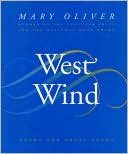
West Wind: Poetry and Prose Poems by Mary Oliver

A sinus infection and a bad internet connection have interrupted my blogging plans, so I have a bit of catching up to do...


You are young. So you know everything. You leap
into the boat and begin rowing. But, listen to me.
Without fanfare, without embarrassment, without
any doubt, I talk directly to your soul. Listen to me.
~ Mary Oliver,
"West Wind #2"


When I was taking Contemporary Lit. in college, I went to a Mary Oliver reading on the professor's recommendation. Afterwards, the professor asked me what I thought. I had connected to the few Mary Oliver poems we read in class, yet... "Well, I enjoyed it. But... um--for a contemporary poet she, well, seemed kind of 'old school' to me."

I couldn't explain I meant by 'old school' at the time, but now I realize that there were two elements in Oliver's work that stumped me.

First, after being told over and over that most of my poems would be better off with the last two lines chopped off, Oliver's conclusions sometimes seemed amateurishly overstated. She was blatant in ways I never could have gotten away with in a college workshop.

Second, Oliver's poems lacked the edginess that I had come to assume was a necessary part of contemporary poetry.

I felt embarrassed by my lack of appreciation for the Pulitzer-winning poet, so it was with joy and relief that I recently ambled through West Wind: Poems and Prose Poems. The author is so delighted with the transient beauty of the world, so full of awe and expectation, that it's no surprise that she seemed a little naive to me. There is no slyness in her work. Reading West Wind is like taking a walk with Oliver in her own backyard. She gives you the weight of her meaning with the same simplicity with which she might hand you an interesting stone. I still sometimes feel the sacrilegious need to lop of a last word or line from some of Oliver's poems ("Pilot Snake," for instance), but I wonder sometimes if this isn't because I've been trained to be less generous in my writing.

I'm a pretty selfish poetry reader too. What I look for most in poet is that "yes" moment. The moment in which I say, "Yes, that's exactly how that is, but I never could have said it that way" or, even better, "How does she know? How does she know it feels just that way, but only to me?" It doesn't matter how beautiful the language or refined the style is, if I don't have that "yes" moment, I leave a poetry collection disappointed. I was not often disappointed with West Wind. I've read the poem "Black Oaks" about six times now. The whole poem is like a "yes" moment, but the lines that clinched it for me were "Listen, says ambition, nervously shifting her weight from /one boot to another--why don't you get going?" It is hard for me to pull a single line out of any one of the poems in West Wind because the lines were made for the poem and not the other way around (which tends to be my temptation when I write), and I don't know when to stop quoting.

There is not a large variation in tone, theme, or subject in West Wind, and this may keep Oliver out of my very favorite poets list, but West Wind is arranged so that the poems build gently on the same ideas. Not many collections feel as perfectly ordered as this one. If she reminds me of a child at the beginning, by "Have You Ever Tried to Enter the Long Black Branches," the last poem in the book, she seems ancient enough to ask, "Do you think this world is only an entertainment for you?" and then explain what the world really is. I find that I accept her credibility as a guide without knowing at what point I gave in.

Wednesday, December 31, 2008

50 Book Challenge & Reading Resolutions

At the beginning of the year, I joined a challenge on the Reading is Sexy Facebook group to read fifty books in one year. I didn't include anything much shorter than the shortest play I read (about seventy pages, I think) or anything I didn't read completely (which is too bad because the Encyclopedia of New York State would have looked amazing on here).

Yesterday, I finished the challenge. Here, purely because I want to see them all together, is my list. Yellow is YA/juvenile/children's lit. Green is fiction. Salmon is poetry. Purple is nonfiction. Blue is drama. The two in black are crossovers (A Book of Ireland is a compilation of Irish writing and Eugene Onegin lives somewhere between poetry and fiction.)


  1. The Accidental Tourist by Anne Tyler

  2. The Great Gatsby by F. Scott Fitzgerald

  3. Dubliners by James Joyce

  4. Yiddish with Dick and Jane by Ellis Weiner and Barbara Davilman

  5. Earthly Astonishments by Marthe Jocelyn

  6. From Fatigued to Fantastic by Dr. Jacob Teitelbaum

  7. Me Talk Pretty One Day by David Sedaris

  8. The Bell Jar by Sylvia Plath

  9. Death Comes for the Archbishop by Willa Cather

  10. Some Writers Deserve to Starve: 31 Brutal Truths about the Publishing Industry by Elaura Niles

  11. Gilead by Marilynne Robinson

  12. The Playboy of the Western World by J.M. Synge

  13. The No. 1 Ladies Detective Agency by Alexander McCall Smith

  14. Ireland (LIFE World Library) by Joe McCarthy

  15. Healing Stones by Nancy Rue

  16. Saints Behaving Badly by Thomas J. Craughwell

  17. Villette by Charlotte Bronte

  18. Of Mice and Men by John Steinbeck

  19. The Trouble with Poetry by Billy Collins

  20. Songs of Innocence and Songs of Experience by William Blake

  21. Irish Saints by Robert Reilly

  22. The Coal Tattoo by Silas House

  23. A Book of Ireland edited by Frank O'Connor

  24. The Brothers Karamazov by Fydor Dostoyevsky

  25. The Pearl by John Steinbeck

  26. The Chosen by Chaim Potok

  27. Terpin by Tor Seidler

  28. How to Read Literature Like a Professor: A Lively and Entertaining Guide to Reading Between the Lines by Thomas C. Foster

  29. World War I and Nationalist Politics in County Louth, 1914-1920 by Donal Hall

  30. Carlingford Town by P.F. Gosling

  31. The Autobiography of S.S. McClure by S.S. McClure and Willa Cather

  32. As I Lay Dying by William Faulkner

  33. Master Harold... and the "Boys" by Athol Fugard

  34. Portuguese Irregular Verbs by Alexander McCall Smith

  35. Traveling Mercies: Some Thoughts on Faith by Anne Lamott

  36. The Irish Story: Telling Tales and Making It Up in Ireland by R. F. Foster

  37. In Praise of Slowness: Challenging the Cult of Speed by Carl Honore

  38. Who Let the Blogs Out? A Hyperconnected Peek at the World of Weblogs by Biz Stone

  39. Sons and Lovers by D.H. Lawrence

  40. Northanger Abbey by Jane Austen

  41. Eugene Onegin by Alexander Pushkin

  42. King Lear by William Shakespeare

  43. Catcher in the Rye by J.D. Salinger

  44. Ethan Frome by Edith Wharton

  45. The Red Pony by John Steinbeck

  46. Woman's World by Graham Rawle

  47. West Wind: Poetry and Prose Poems by Mary Oliver

  48. Praying in Color by Sybil MacBeth

  49. The Power and the Glory by Graham Greene

  50. Mere Christianity by C.S. Lewis

  51. Jacob Two-Two Meets the Hooded Fang by Mordecai Richler

(If I didn't feel so lazy, I'd have more hyperlinks here.)

About 20 of these come from my favorite Greatest Literature list. About 10 were directly related to research for my book (several more were indirectly related). Perhaps what surprises me the most about this list is the amount of nonfiction I read.

I'm starting the challenge again for 2009, but I don't think I'll be very particular about whether or not I get to fifty next year. I already know I can do it, and right now I'm much more interested in finishing the book I'm writing. I would, however, like to read more poetry and drama this coming year, particularly poetry.

Monday, December 29, 2008

Pictures of Books on My Shelves

My brain works in strange ways when I'm sick. I woke up this morning and thought, My books are so pretty! I love them! Also, I like looking at pictures of other people bookshelves (though perhaps in a somewhat covetous way). So here are pointless pictures of my books.


My "borrowed" books:


The bookshelf I see first thing in the morning:


The bookshelf in the closet:


The bookshelf built between the air-duct and the wall (and another bookshelf):

Sunday, December 28, 2008

Woman's World by Graham Rawle


I received Woman's World as birthday present from a fellow English major. I have mixed feelings as I write about this novel. On the one hand, Graham Rawle's Woman's World is an incredible work: satirical, visually appealing, carefully structured, etc. On the other hand, I'm having trouble thinking of people I could recommend it to without repercussions.

Without giving anything away, I think it's fair to say that that some of the explorations of gender in this novel are unsettling, and without Rawle's light touch they could have been even more so. Also, (like a lot of satire) this book is at least as tragic as it is funny.

That said, Woman's World is brilliant.

First, you have a novel that's been created entirely from words clipped from 1960s women's magazines. That idea alone made me want to love it: the collage of different typefaces; the bizarre, materialistic language of advertising put into everyday life; the questions of femininity and how its image is shaped...

Second, Rawle does not skimp on plot structure. Woman's World is not merely an interesting gimmick, but a well-spun tale. The pacing is slow for a novel that plays off the rhythm of the mystery and romance genres, but this didn't bother me because it became a stylistic foreshadowing that the story and characters were going to become more complicated than initially suggested. (Afterwards, I kept trying to think of ways he could have changed the novel, and nothing I came up with in my head was as believable, satisfying, or appropriate to the tone of the book as what Rawle had already done.)

Third, Rawle plays with language in hilarious ways. The characters become straight (wo)men to his comic brilliance:
I sat perfectly still, going over and over everything in my mind, thinking about what I should and shouldn't have done, and wondering what was going to happen to me. [...]Not killed Mr. Hands--that's what I should have done.
Also, Rawle's toying with the language of women's advertising makes Woman's World full of images like
I threw back my head and with closed eyes let the words of admiration flood over me like a family-size can of Carnation evaporated milk.
Or...
I felt very vulnerable there, facing the double-edged sword of being spotted by Mrs. Price and having Mary open the living-room door and see me with my coat on. Life is a bowl full of pickles, and here I was, a butterfly trapped in the stuff.

Finally, although the novel is full of strange situations and satiric language, the responses of the characters are psychologically believable. I ended up feeling a great deal of sympathy for the main characters, even as I giggled at Rawle's expressions.

I'm sure I must know some people who are strange enough to enjoy this book too. Which reminds me... thank you, Cara, for the birthday gift.

Saturday, December 27, 2008

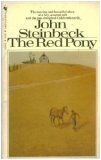
The Red Pony and "Junius Maltby"


Even when I don't like Steinbeck, I like him. I prefer The Red Pony to The Pearl, but neither of them are really favorites of mine. (I'm more of an East of Eden and Of Mice and Men fan.)

However, Steinbeck does "straightforward yet subtle" better than any writer I know. The action doesn't exactly build in this collection; each story has it's own moment of crisis, but I loved how Steinbeck's theme of violence and its relationship to "becoming a man" wandered through the stories and sat down at the simple conclusion (though I still felt like I wanted more out of the last story in The Red Pony).

My copy of The Red Pony tacked the short story "Junius Maltby" (part of the Pastures of Heaven collection) to the end: an unusual addition. "Junius Maltby" is a fine story, but it has parable quality that seems at odds with The Red Pony's more realistic style. But both of the stories play with the elements of boyhood, and The Red Pony is so short that few publishers seem willing to print it alone. (You'll find copies of the The Red Pony with The Pearl or Tortilla Flat on Amazon, but very few of just The Red Pony.)

I'm surprised that this novella/collection is so frequently assigned in early high school (perhaps because of length and the age of the protagonist?)--I think the ending would have been frustratingly anti-climatic for me at that age. But maybe I'm not giving high schoolers enough credit.

Side Note: Apparently, Aaron Copland did the music for the 1949 movie version of The Red Pony. I don't have much desire to see the movie, but I'd love to hear the soundtrack.

Tuesday, December 23, 2008

Yes, This is a Real Company

Sorry for the long silence. I've been itching to get back on here, but lately my internet access has been sketchy at best.

However, consider this an early Christmas present.