Sunday, December 14, 2008

Happy Birthday to Me!


I thought I would try to find what sort of connections my birthday had to important literary events. Today in Literature tells me that Aphra Behn was baptized on this date (most of her early life is unknown). The Writer's Almanac says I share my birthday with Shirley Jackson and Amy Hempel. Also, Charles Schulz retires and quantum theory is born.

Not too bad a day.

Thursday, December 11, 2008

Introducing the Book

Because I had other things I wanted (needed) to do today and I love this.

Tuesday, December 9, 2008

Ethan Frome


Just a few paragraphs into Edith Wharton's Ethan Frome, I couldn't help thinking, I've read this before, only then it was called The Age of Innocence and it was longer.

That turned out to be a fairly accurate assessment of Wharton's novel (novella). The main difference is the setting and the "twist" ending (which felt a bit cheap and expected to me). Beyond that, both of Wharton's novels deal with an adulterous passion (which can never be completely fulfilled) and an overwhelming sense of (tragic) fate. Ultimately, I preferred Age of Innocence, with its more subtle sense of fate and more realistic ending. Ethan Frome seemed a bit like an experiment in authorial cruelty. (The ending of Ethan Frome is so exaggerated that it seemed almost humorous.)

Also, everything I read implies that Zeena should be viewed as a tyrannical, selfish being, but she was so caricatured that I started to feel sorry for her. I started to think, Well, of course she acts all mean and suspicious; she thinks you want to have an affair with her cousin. Oh wait--you do! Her doubtful illnesses started to seem like desperate attempts to get some kind of attention from her husband. It wasn't difficult to see why Ethan liked the sweet, inadept Mattie Silver in contrast to his wife. But I had a hard time feeling he had a good reason to cheat. Not that I ever feel there's a really good reason for someone to cheat on his or her spouse, so maybe that sums up my problem with the novel right there. In Age of Innocence, however, I didn't feel as annoyed about Countess Olenska cheating on her husband (he was cheating on her already and she was continually talked out of divorcing him for the sake of her family--which sounds a lot like Wharton's own marriage).

I guess I'm not on quite the same page as the young woman who said, "I love Edith Wharton. Her stories are so depressing!"

Monday, December 8, 2008

On (Not) Using Characters as Moral Centers, Part 2


So just a couple days after I blogged about using characters as moral centers in fiction, I was brushing my teeth (Have you noticed that all epiphanies come during personal hygiene moments?), and I thought, What on earth were you talking about? Not that I suddenly dislike using characters as moral centers, but I realized that the character I'd been thinking about using as a moral center wasn't going to work at all. In the back of my brain, I guess I've kind of known she wasn't supposed to be that sort of character for a while now.

There are several reasons the character I had in mind can't be my moral center--most too difficult to explain here. But I think it can't be a coincidence that most of the characters who fulfil the role of moral center in literature are generally secondary characters (a notable exception would be Atticus Finch from To Kill a Mockingbird, but we see him through the memories of his daughter, Scout, so there's still a bit of distance between him and the reader). Moral centers may have amazing personal histories, but generally, they just pop in and pop out of the story as needed: like an occasional angelic visitation. Somehow, the more you know about a person's past, the harder it is to accept his or her moral authority. (Jesus' problem when he went back to his hometown of Nazareth. "Look who's the big shot now. Ha! I used to change his diapers!")

It's the skillful writer who can create believable moral authority in a well-detailed character. An example of this might be Bishop Myriel in Victor Hugo's Les Miserables. The Bishop may still technically be a secondary character (Hugo's "brief" character sketches are chapters long), but before his scene with the protagonist, Jean Valjean, the reader already knows how many chairs the Bishop has in his house, that he is generous to a fault, the sort of notes he makes in the margins of his books, his thoughts on politics, and that he has given up his house for use as a hospital. This not only makes the later scene with the candlesticks believable, but somehow the sincerity of the Bishop's portrayal allows the reader to accept the sincerity of the change he triggers in Valjean.

Even the best writers seem to struggle with using a moral center as a primary character. A few months ago, I tackled The Brothers Karamazov. The young novice Alyosha is obviously Dostoevsky's moral center, and the reader gets to spend a good deal of time with him. Dostoevsky wrote some marvelous scenes with Alyosha, but after a while, Alyosha's goodness becomes annoyingly dull. I tired of following him because there was little question about how Alyosha would respond to situations.

I'm still trying to decide what I'm going to do in my novel. Since I'm playing with multiple narrations, I actually have a choice to make with each storyline, which is both exciting and scary. I realized that in at least one of my storylines I already have an obvious moral center character who I've been ignoring. I may do something completely different with my other storylines. Of course, the acceptance of a character (moral center or not) as "believable" depends on the specific reader, but right now I'd be happy if I could just please the writer.

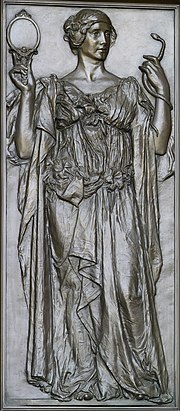
Side Note: The image above is Olin Levi Warner's Truth with a mirror and serpent from the Library of Congress because... well, just because I got tired of searching for images in the public domain.
Sunday, December 7, 2008

The Catcher in the Rye


I recently finished The Catcher in the Rye by J.D. Salinger--the iconic novel of adolescence that everyone read in high school, except me.

I enjoyed Catcher in the Rye a lot more than I expected to: great style, hits every basic literary theme, a believable narrator, etc. But I seem to feel more ambivalent about the book than most readers. Ed. Williamson on Epinions.com notes that from its publication date, Catcher in the Rye slammed "into the American consciousness with all the subtlety of a herd of bulls in a china shop." Most of the comments I heard before reading were that it was a "whiny, emo book" loved only by people who were emotionally immature (which made me fearful) or that it was THE only Great American Novel (which made me sceptical). Possibly its only unargued position in the literary cannon is as both one of the most widely assigned, and the most widely banned, novels in U.S. high schools.

After A Home at the End of the World by Michael Cunningham and Tales of Burning Love by Louise Erdrich, Catcher in the Rye seemed fairly tame. In spite of his language, drinking, and nervous sexual endeavors, Holden strikes me as a bit of an innocent. Being far enough removed from high school, I feel a sort of maternal sympathy/concern for him (and, at times, a maternal desire to shake some sense into his head). But in high school, yes, Salinger's hero would have annoyed and disturbed me.

It's amusing/sad that this novel is now considered a "teen" book and almost exclusively assigned in high school (Huckleberry Finn suffers a similar fate). I actually find it more interesting (read: "less painful") to read about adolescence now that I'm done with it. When I was a teenager, I preferred books that explored (an exciting) adulthood.

Side Note: While we're on the topic, here's something wonderful: Catch Her in the Oatmeal.

Thursday, December 4, 2008

Cartoons on Writing, Or an Oddly Comic Depressing Look at the Writer's Struggles

It's late, and I'm still working off an unreliable internet connection. So here are some writers' issues as discovered by ANDERTOONS:

1. The Fear of Greatness
What I think every morning.

2. Social Issues/A Sense of Inadequacy
We know all writers (all good writers, anyway) are supposed to mingle at 1920s-style cocktail parties. This is why I can't.

3. Selling Out
He may be abandoning his tragic genius, but post-meaning poetry sells, apparently.

Wednesday, December 3, 2008

Gifts for the English Major in Your Life... Part Deux

Sorry for the long silence; my laptop is in the hospital, and I've had a little trouble finding a reliable internet connection.

To continue the last post...


A Cup of Creativitea by Tea Talk. Also available at Signals, Amazon, Expressions, etc. Tea and writing just seem to go together like, well, bookstores and coffee shops.


English Major Stereotypes sweatshirt. Similar shirt available from Zazzle.com.


Poetry Comics: An Animated Anthology by Dave Morice. This is a strange, strange little book. Sometimes, its interpretations are funny; often they are terrifyingly surreal. I find it delightful, without knowing exactly why.


Old Typewriter Key Jewelry from What's Your Type. Like we needed more pics of jewelry on here, but I really love typewriter key bracelets. I'm just too frugal (read: "poor") a writer to buy any.