Showing posts with label children's lit.. Show all posts

Tuesday, March 17, 2009

Irish Tales Retold for Children

In honor of Saint Patrick's Day, I'd thought I'd mention a few children's books based on Irish legends that I've had the pleasure of reading lately.

I've noticed that the older the Irish legend, the less appropriate it seems for a children's book. Several storybooks present these tales "as is," leading to the sort of faithful and depressing retellings I would have disliked as a child. I believe, however, that my childhood self would have approved of the books below.
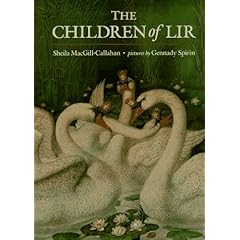
The Children of Lir written by Sheila MacGill-Callahan, illustrated by Gennady Spirin. I actually like the sadder, more familiar, Christianized version of this story better, but as a child, I would have appreciated MacGill-Callahan's happy ending, the addition of Jasconius the whale (borrowed from the legend of Saint Brendan), and the large role played by animals throughout the story. Spirin's detailed illustrations are both fantastical and formal, reminding me of a Renaissance stage play.


The King of Ireland's Son, told by Brendan Behan and illustrated by P.J. Lynch, was transcribed from a audio-recording of Behan, and the text vibrantly reflects the best qualities of oral storytelling. The story is light-hearted and lyrical, and Lynch's pictures are a perfect match: the characters are lovingly detailed and humorously expressive.
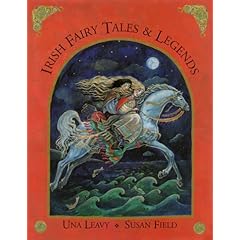

Irish Fairy Tales and Legends, written by Una Leavy and illustrated by Susan Field, is possibly my favorite of the three. First, you get ten tales to delight in, instead of one. Second, Leavy does the best job I've ever read of staying true to the nature of old Irish legends while fitting them into a language and tone appropriate for children. Third, the collection is a generous mix of serious and comic stories. Fourth, Field's pictures are absolutely marvelous: expressive, warm, colorful, and childlike.

(Images from Amazon and LitWeb. )
Tuesday, February 10, 2009

Gaelic Ghosts by Sorche Nic Leodhas

The ghosts in Gaelic Ghosts by Sorche Nic Leodhas (aka LeClaire Gowans Alger) are the least frightening, most good-natured haunts you'll meet in a long time. Half the fun of Nic Leodhas' stories resides in the telling. Nic Leodhas' writes the stories as they would be told by an expert Scottish storyteller. The written brogue is natural and wry, and not so thick that it's unbelievable (if you've ever read Caleb Balderstone's dialogue in The Bride of Lammermoor, you know what unreadable brogue looks like).

Gaelic Ghosts includes about 20 woodblock illustrations by Nonny Hogrogian, but book remains fairly text-heavy, although short (110 p.).

In this collection of ten non-terrors, the task of ghosts is not so much to frighten but to correct a wrong. In "Sandy MacNeil and His Dog," "The Grateful Old Cailleach," and "The Old Laird and His Dogs" the ghosts reward and protect those they "haunt." In "The Giant Bones," "The Gambling Ghosts," "The Walking Boundary Stones," "The Lady's Loaf-field," and "The Holy Relic of Bannockburn" hauntings serve to set people back on the straight and narrow. Most of all, however, the ghosts serve as reminders not to value the past too lightly.

Gaelic Ghosts ends on the farcical tale "The House that Lacked a Bogle." My memory is that this story (or a very similar version) appeared in a Halloween issue of the children's magazine Cricket, and several online sellers are marketing Gaelic Ghosts as a children's book. I hadn't considered the book a children's collection while I was reading it, but like the best folktales, the stories in Gaelic Ghosts should amuse readers across a wide span of ages.

Friday, January 23, 2009

Jacob Two-Two Meets the Hooded Fang


I'm not quite sure what to make of Mordecai Richler's Jacob Two-Two Meets the Hooded Fang (illustrations by Fritz Wegner, who I know for The Little Cat Baby).

On the one hand, I feel compelled to give it points for being such an odd, funny little book. The situations in the story become crazier and crazier, building on hilarious horrors like a children's prison with a Happy Nightmare Hour and an agent of evil who secretly puts puzzle pieces in the wrong boxes, so no one can ever solve them. Richler also plays on children's delight in stories where most grown-ups are villainous and must be outwitted by resourceful kids (think Roald Dahl). And I love the "reveal" with the Hooded Fang at the end.

On the other hand, I keep wondering about Richler's audience. The 1975 New York Times reviewer claimed, "I haven't the vaguest idea who it's written for and don't care," but I want to know who the target age group is. Amazon.com suggests a reading range of 9 to 12. Jacob Two-Two, however, is is only "two plus two plus two" years old, and protagonists are rarely younger than their intended readers, so I would assume that the readers are meant to be those who most identitfy with Jacob's inability to "ride two-wheeled bicycles, dial a telephone number, whistle, do joined-up writing, play checkers, and catch a ball." Yet the reading level and humor of the book seem beyond most six-year-olds. The book could be read aloud (it seems to written for that purpose), but some of the things that would be funny to an eight-year-old would still be confusing to a six-year-old (i.e. dream sequences that aren't explicitly explained and fears of a real court that might lock up children for accidentally insulting "big people").

Ah. I have just found a review of Jacob Two-Two and the Dinosaur (the sequel to The Hooded Fang) that recommends pushing the reading age up to 9 because of the cynical humor of the book, particularly in regard to authority figures.

Apparently, none of my concerns have kept Jacob Two-Two from popularity. I was surprised to find a recent television series based off of Jacob Two-Two, as well as two movies, and, of course, the rest of the book series.

Tuesday, January 20, 2009

Rumpelstiltskin

Research into variations of a certain form of fairytale led me to The Complete Fairy Tales of the Brothers Grimm translated by Jack Zipes, and now I'm all caught up in discovering stories I've never read before and rediscovering childhood favorites. (Note: Those familiar with the grotesqueness of original fairytales will know why I wasn't introduced to many of these as a child... and the Grimms' versions are still considered "sanitized.") In my mind, as in fairytales, one thing leads to another, and I started to think of interpretations of various stories...

So, today, "Rumpelstiltskin" (sometimes Rumpelstiltskin):


Vivian Vande Velde's The Rumpelstiltskin Problem will always be a favorite of mine. In her introduction, Velde complains that Rumpelstiltskin is the most convoluted and illogical of the popular fairytales (i.e. Where does a poor miller's daughter get a ring and gold necklace? And why would you want them if you could spin straw into gold? And doesn't the king sound like a horrible sort of husband?). Each of Velde's six tales reinterprets "Rumpelstiltskin" in a different and delightful way, while filling in some of its plot holes.


In the realm of picture books, it seems like there's Paul O. Zelinsky's Rumpelstiltskin... and then somewhere at the bottom of the ladder there's every other version. Zelinsky's illustrations are rich and glowing, and I love his Renaissance details (i.e. "the strange little man" has a gold piece attached to his hat brim as a sign of his trade). I didn't think another illustrator could hold a candle to this version...


...until I saw The Girl Who Spun Straw into Gold written by Virginia Hamilton, illustrated by Leo and Diane Dillon. The story is based on a West Indian version of "Rumpelstiltskin." The Dillons' illustrations are lavish: gold-leaf, scrumptious clothing, and architecture that is almost a character itself. I particularly love the changes in the illustrations as Quashiba moves from being afraid of to being ticked off at her greedy husband.

There are several story-cousins to Rumpelstiltskin. One of the funniest in my Brothers Grimm collection is "The Three Spinners," in which three strange-looking women help a lazy maiden complete an impossible spinning task and get her out of ever having to spin again. More recently, the January 1994 (vol. 12, no. 5) issue of Cricket published "The Old Woman and the Imp" written by Sophie Masson, illustrated by George Riemann, in which the "imp" (obviously, though unnamed, Rumpelstiltskin) matches wits with an old spinner who is just as sneaky as he is.

Because you've all been so good: The Fractured Fairy Tales version by A.J. Jacobs and an odd little poem.

(Book cover images from Vivian Vande Velde, Amazon.co.uk, and Children's Books for Parents.)

Tuesday, January 13, 2009

Not Just for Kids

I suppose it says something about my immediate family that no one in it is under twenty and yet there were still several children's picture books given out this Christmas. Among these were...


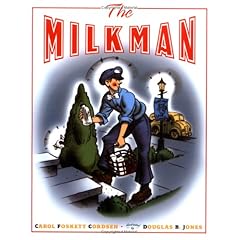
The Milkman written by Carol Foskett Cordsen, illustrated by Douglas B. Jones. Cordsen's rhyming sentence fragments read aloud well. While a few of the phrases may be unfamiliar to young children, they should become obvious in the context of Douglas' illustrations. The illustrations are uber-nostalgic (and reminiscent of Mike Mulligan and His Steam Shovel). Young readers will love watching for the milkman's cat and the "missing" puppy.


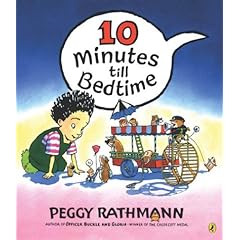
Ten Minutes till Bedtime by Peggy Rathman (of Goodnight, Gorilla and Officer Buckle and Gloria fame). This is one of those "short" bedtime stories that can take forever to read, especially if you want to count all the little hamsters, and heck, I know I do!


Loud Emily written by Alexis O'Neill, illustrated by Nancy Carpenter. I imagine that this story could cause some trouble when parents say, "Use your indoor voice" ("But Emily's loud, and she saved everyone from being smashed to bits!"), but I love that this book is about a young girl who speaks up (quite literally) and finds her place in the world. Also, the story follows the deliciously bizarre logic of children's-picture-book world, and Carpenter's American folk-style illustrations are the perfect expression for Emily's outlandish adventures.

Tuesday, November 18, 2008

Favorite Children's Picture Books 2

There's a children's book I remember loving but I can't find anywhere online or in my parents' attic. It was about a little green fish, and I seem to remember a white duck and a little girl and some bread crumbs (sort of abstract, almost Asian illustrations, at least in my memory). The story was printed on a square board book and the cover was blue with the green fish on it (or possibly the other way around). I can't remember whether or not the book was wordless or just economical with language. I think it was called something like Fish or The Little Fish. Anyone remember this?

I did find some other favorites while searching through the attic/online. Like


But Not the Hippopotamus by Sandra Boynton.


The Delicious Plums of King Oscar the Bad by Rick Schreiter.

Follow the Line by Demi. An enthralling wordless book. (I can't find my copy or a photo to post here, so click on the link.)

Monday, November 17, 2008

Favorite Children's Picture Books

I did some Christmas shopping today and spent too much time looking through picture books and thinking about my childhood favorites.

Everyone remembers Goodnight Moon, but here are some I'm not sure everyone knows.

Little Rabbit's Loose Tooth written by Lucy Bate, illustrated by Diane De Groat. What I loved the most were Little Rabbit's plans about what to do with her tooth instead of giving it to the tooth fairy.

Grandfather Twilight by Barbara Helen Berger. Beautiful, beautiful illustrations.

Little Daylight written by George MacDonald, illustrated by Erick Ingraham. One of George MacDonald's loveliest fairytales, and Ingraham's illustrations made me want to be an artist as a kid.

Whose Mouse are You? by Robert Kraus. Silly even for a children's book, but I adored it. Hurrah for mice who don't accept defeat.

Chicken Soup with Rice: A Book of Months by Maurice Sendak. Sendak is not an unknown in children's literature by any stretch of the imagination, but I don't hear a lot of talk about this book. I learned all my months through their relationship to chicken soup with rice. Chicken soup with noodles, to this day, seems like a bit of a disappointment.

There are many others, but I'm having a little trouble remembering the titles of, or finding, the picture books that are a little more obscure.